Ryne Sandberg

| Birthdate | 9/18/1959 |
| Death Date | 7/28/2025 |
| Debut Year | 1981 |
| Year of Induction | 2005 |
| Teams | Cubs, Phillies |
| Position | Second Base |
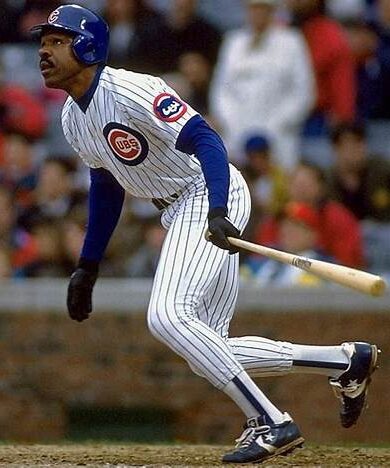
Ryne Sandberg won 9 straight Gold Gloves and went to 10 straight All Star games. He retired with the highest all-time fielding % for second baseman.
Leave a commentIn the collection:
Sandberg was named after pitcher Ryne Duren; his brother was named after Del Ennis
Sandberg was named after pitcher Ryne Duren; his brother was named after Del Ennis
Ryne Sandberg comes from a baseball family. His father Derwent “Sandy” Sandberg loved the game so much that he named Ryne’s older brother after former NL RBI champ Del Ennis.
When Sandy’s wife Libby became pregnant again with a boy, the two decided to name him Ryne after reliever Ryne Duren.
Duren possessed a blazing fastball that kept him in the big leagues for ten seasons. He also had poor eyesight that kept him in the minors for 9 years.
By the time he reached the majors to stay, Duren made quite an impression. From 1958-1961 he was selected to four All Star Games and pitched in two World Series.
Ryne Sandberg progressed even farther than his MLB namesake, earning baseball’s highest honor as a 2005 inductee to the Hall of Fame.
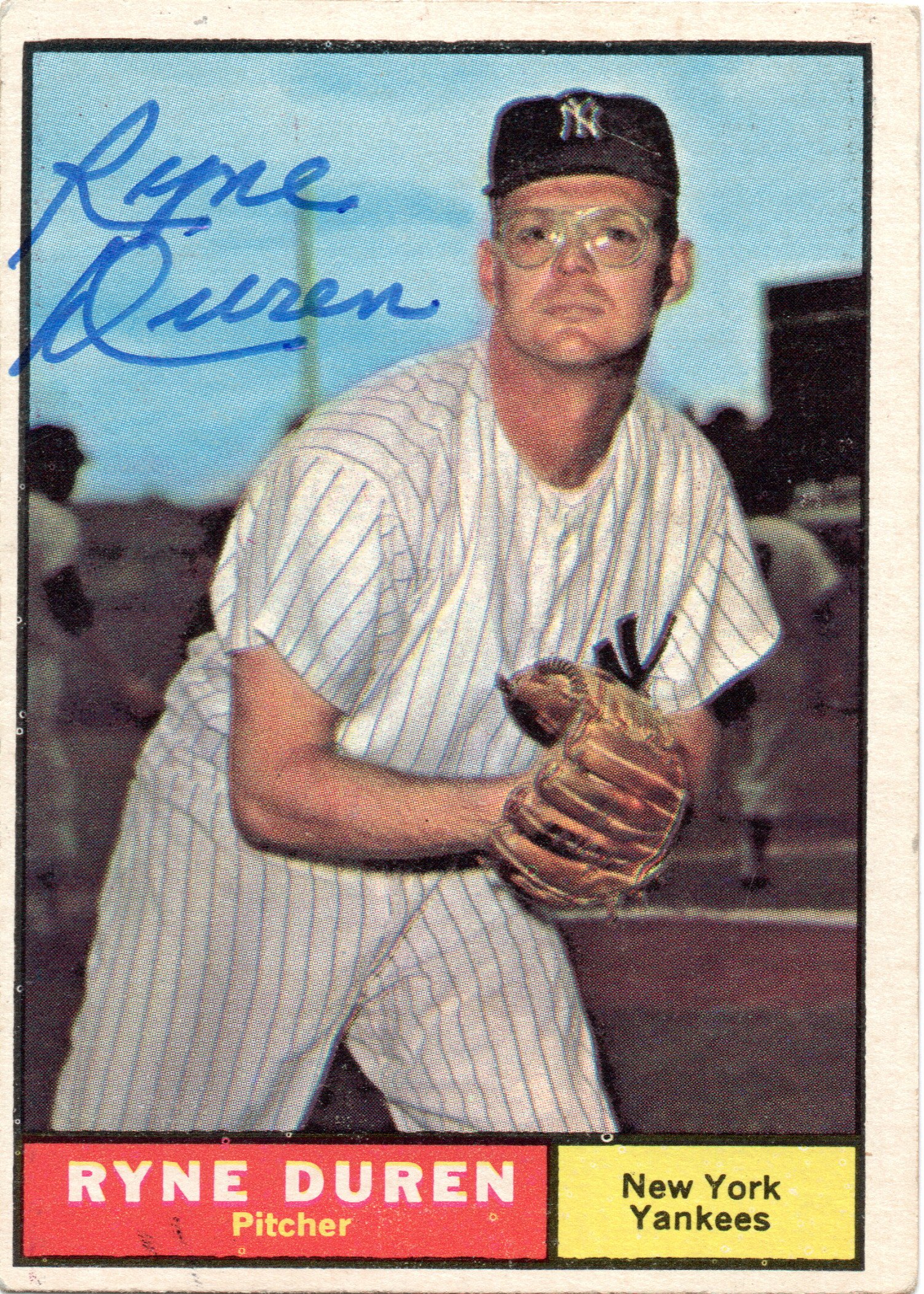
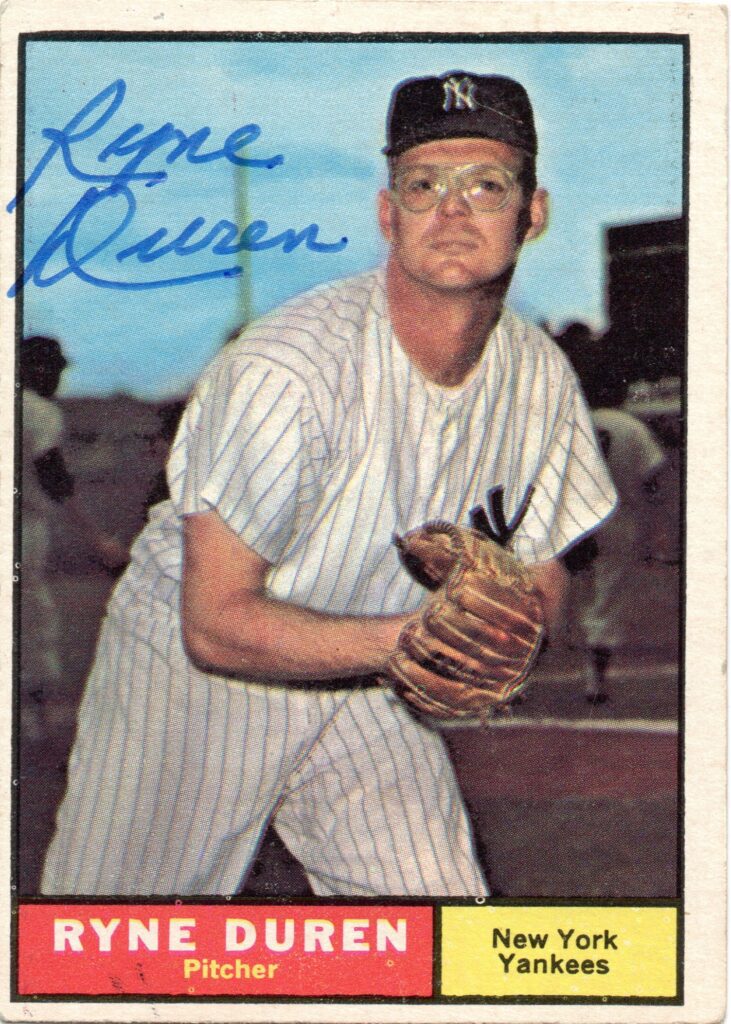
Shown here is an autographed 1961 Topps card of Duren. Much more about the pitcher’s career can be found by clicking here.

The Phillies trade of Larry Bowa and Ryne Sandberg for Ivan DeJesus is one of their worst
The Phillies trade of Larry Bowa and Ryne Sandberg for Ivan DeJesus is one of their worst

Few careers pivot on a decision as sharply as Ryne Sandberg’s did in 1981. He opened with the Philadelphia Phillies, appearing in just 13 games behind 35-year-old Larry Bowa. Philadelphia’s brain trust viewed Sandberg’s future as a utility man, not a cornerstone.
Depth across the infield reinforced that belief. Sandberg logged time at second and third in the minors, yet no clear lane emerged. The Phillies trusted Manny Trillo at second and leaned on Hall of Famer Mike Schmidt at third. With key spots secured, the front office focused on finding a long-term answer at shortstop.
That urgency produced a fateful trade. Philadelphia sent Bowa and Sandberg to the Chicago Cubs for Ivan DeJesus. At the time, the deal filled a perceived need. In hindsight, it ranks among the worst in franchise history.
Bowa provided steady production in Chicago. Over three seasons as the regular shortstop, he collected 343 hits, 49 doubles, and 14 triples. DeJesus also logged three remaining seasons as a regular. His numbers closely matched Bowa’s, totaling 366 hits, 51 doubles, and 14 triples.
Sandberg’s path soared in another direction. He grew into a perennial All-Star and complete player. Over his career, he earned ten All-Star selections, nine Gold Gloves, and seven Silver Slugger Awards. His 1984 season brought the National League MVP. Chicago gained a franchise icon, while Philadelphia let one slip away.
Shown here is Topps’ 1970 Phillies Rookie Stars card featuring Bowa who signed the card boldly.
When the Cubs won the division in '84 Sandberg earned the Gold Glove, Silver Slugger and MVP
When the Cubs won the division in '84 Sandberg earned the Gold Glove, Silver Slugger and MVP
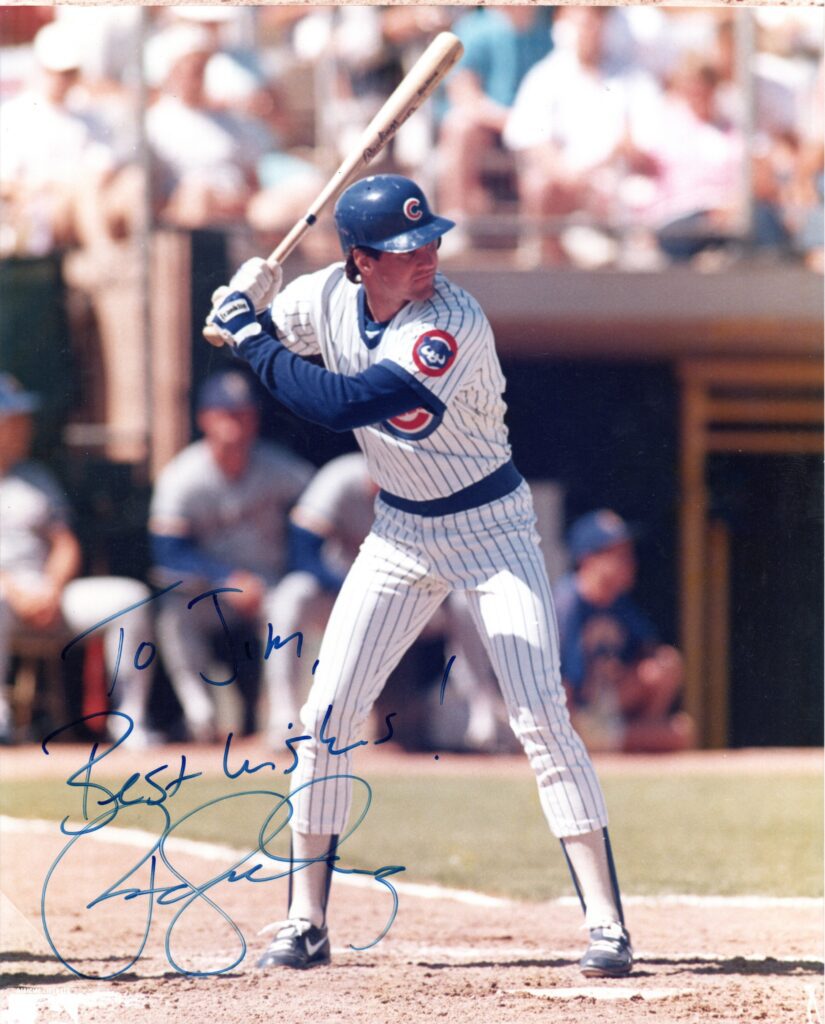
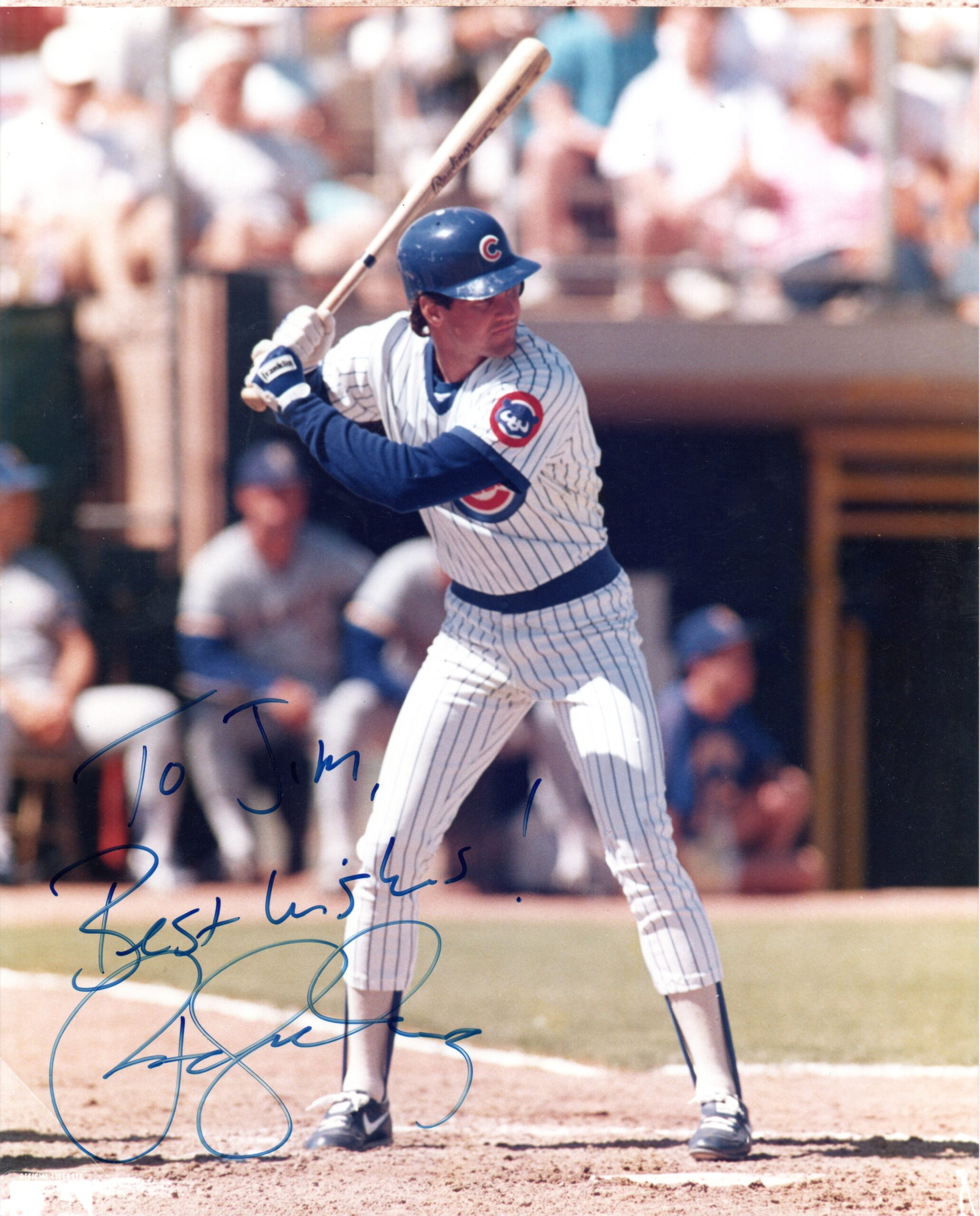
The 1984 season turned second base into a spotlight for Ryne Sandberg, and the Chicago Cubs surged with him. Chicago won 96 games, captured the Eastern Division, and ended a drought dating to 1945. Wrigley Field buzzed with October anticipation as Sandberg set the tone.
April tested his rhythm. He hit .259 with two homers and 14 RBI, still searching for timing. Then May flipped the script. Sandberg torched pitching and earned National League Player of the Week honors from May 7 through May 13. He slashed .448/.500/.621 during that stretch and lifted the lineup nightly. By month’s end, he pushed his average to .325 and seized control of games.
June brought more thunder and polish. Sandberg secured another Player of the Week award and claimed Player of the Month honors. His bat stayed loud, and his glove stayed pristine. July introduced him to the All-Star stage, the first of ten straight selections. He handled every moment with crisp defense and relentless contact.
By season’s end, accolades matched production. Sandberg claimed his first Silver Slugger Award and added the second of nine consecutive Gold Gloves. He led the league with 8.5 WAR, anchoring both sides. His totals told the story: 200 hits, 36 doubles, 19 triples, and 114 runs scored. Those numbers fueled Chicago’s charge to the division crown. The Cubs returned to postseason play, and Sandberg stood at the center of it all.
Shown here is an 8×10 photo autographed by the 1984 National League Most Valuable Player Ryne Sandberg.
The Cubs lost the '84 NLCS despite Sandberg's .368 average and .455 on-base percentage
The Cubs lost the '84 NLCS despite Sandberg's .368 average and .455 on-base percentage
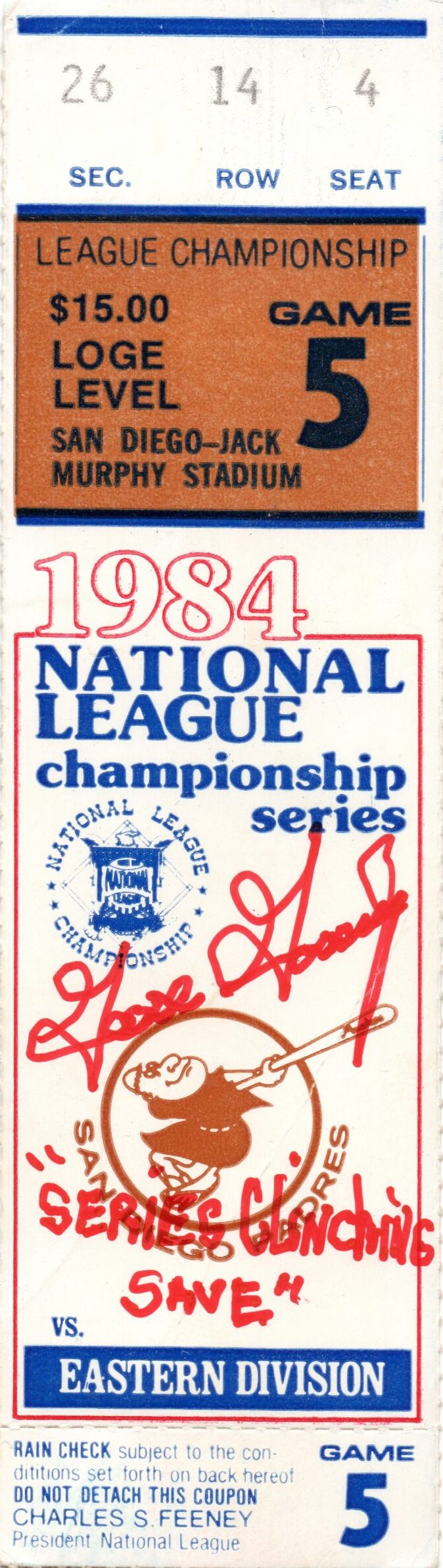
Fresh off his MVP season, Ryne Sandberg carried enormous expectations into the 1984 National League Championship Series. The Chicago Cubs believed their long postseason drought finally might end. Sandberg certainly did his part. The star second baseman collected seven hits in 19 at-bats, drew three walks, and posted a .368 average with a .455 on-base percentage. He also added two doubles, two RBI, and three runs scored during the five-game battle.
Despite Sandberg’s production, the San Diego Padres captured the series in dramatic fashion. Chicago handed the ball to Cy Young winner Rick Sutcliffe for the deciding Game 5 and quickly built a 3-0 lead. Sutcliffe cruised early before San Diego broke through during the sixth inning. Three straight baserunners opened the frame, and two sacrifice flies suddenly trimmed the margin to one run.
Momentum completely shifted in the seventh. Carmelo Martinez walked, then Gary Templeton advanced him with a bunt. Tim Flannery followed with a routine grounder that slipped through Leon Durham’s glove for a costly error, allowing the tying run to score. Moments later, Tony Gwynn ripped a two-run double before Steve Garvey drove home another run with a single.
Manager Dick Williams then summoned closer Goose Gossage for the final six outs. Gossage surrendered only one hit, a Sandberg single, and slammed the door on Chicago’s season. The featured ticket bears Gossage’s signature along with the inscription, “Series clinching save.”

Ryne Sandberg had five campaigns as an All Star, Silver Slugger and Gold Glover
Ryne Sandberg had five campaigns as an All Star, Silver Slugger and Gold Glover

Five times, Ryne Sandberg reached a rare peak, pairing All-Star status with Gold Glove and Silver Slugger honors. Those seasons showcased a complete player who dominated both sides of the game. He blended smooth defense with steady power, setting a standard at second base.
The run began in 1984. Sandberg captured National League MVP honors and powered the Chicago Cubs to their first postseason appearance since World War II. He controlled the infield with precision and anchored the lineup with timely hits.
Success carried into 1985. Sandberg again earned All-Star recognition while securing both the Gold Glove and Silver Slugger. He confirmed that his breakout year in ’84 marked the start of sustained excellence, not a fleeting surge.
Another run arrived in 1989. Sandberg launched a three-year stretch of dominance, collecting All-Star selections, Gold Gloves, and Silver Sluggers each season. He flashed the leather and handled the lumber. Opponents found no weakness to exploit.
Collectors remember that era through unique memorabilia. A 1989 contract extension between Sandberg and Topps baseball cards captures the moment. He signed the agreement in his third campaign of earning all three distinctions.
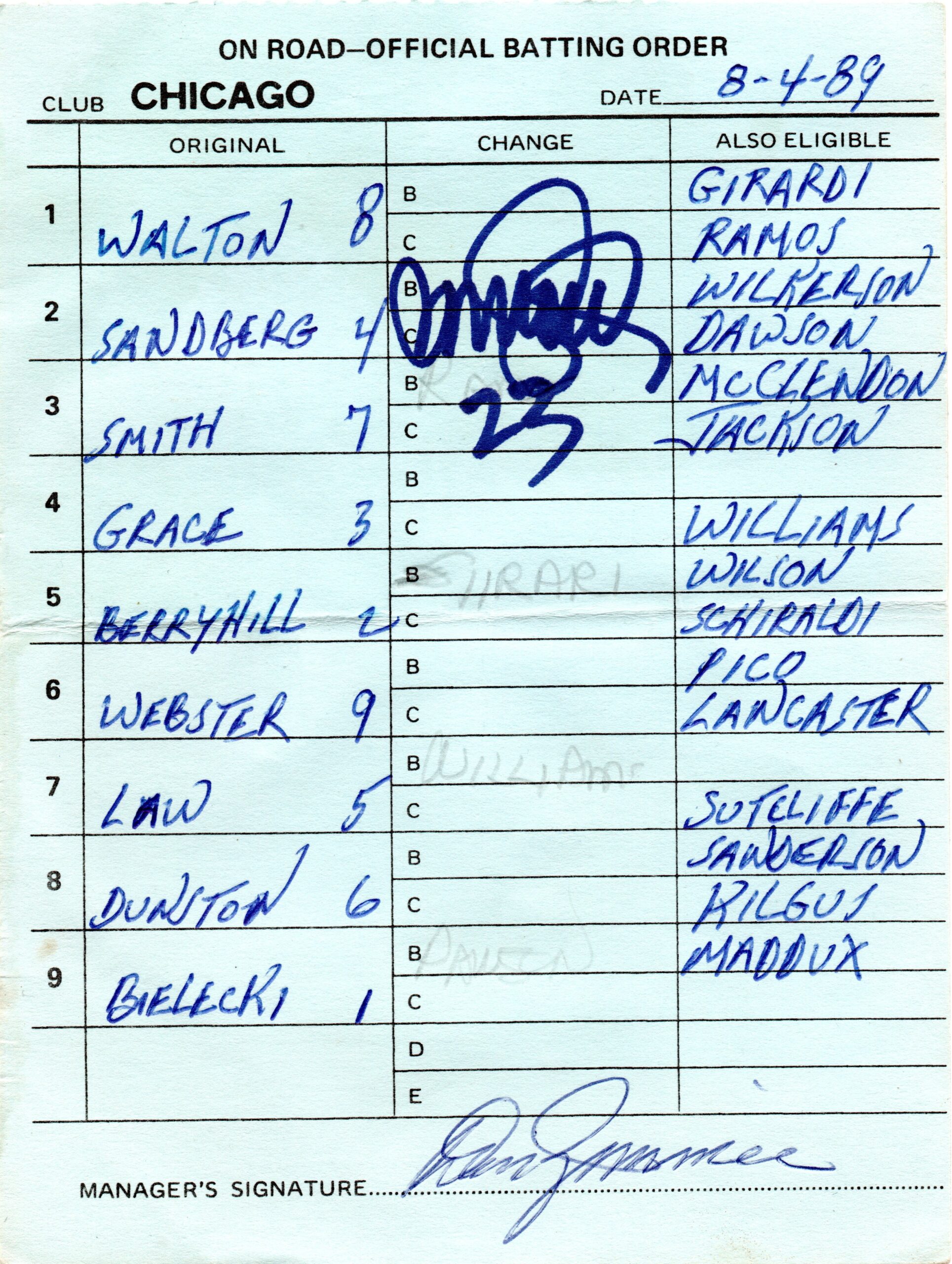
Ryne Sandberg climbed up the Cubs record books in a milestone night at Pittsburgh
Ryne Sandberg climbed up the Cubs record books in a milestone night at Pittsburgh
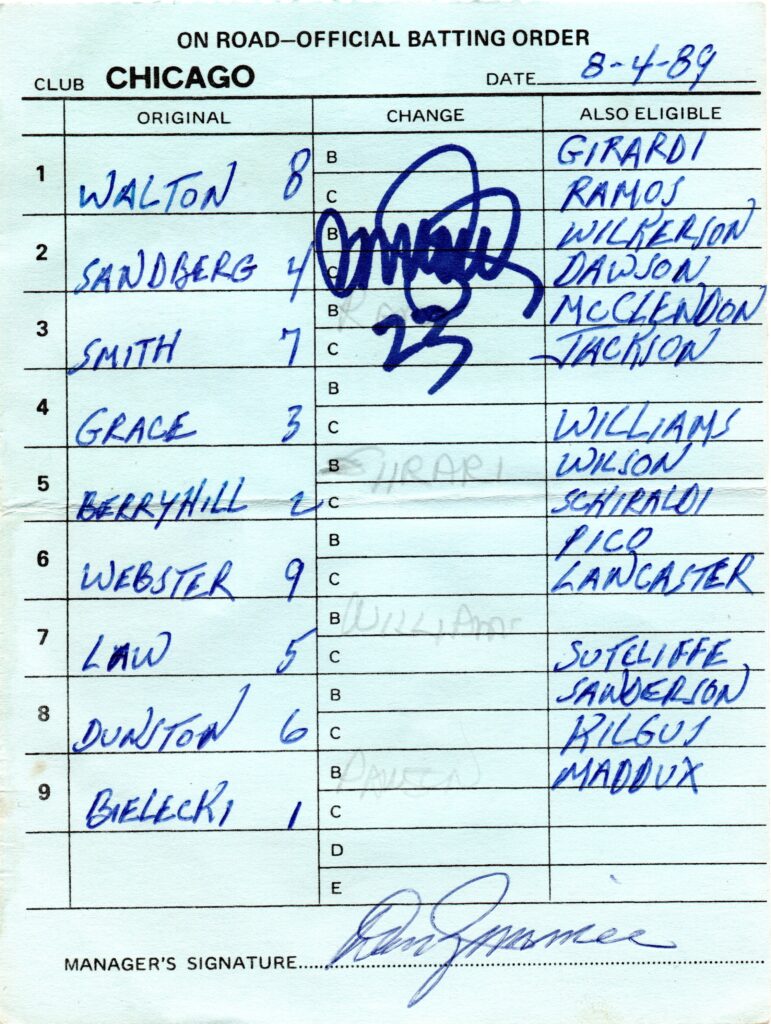
Ryne Sandberg spent his career climbing the Chicago Cubs’ all-time leaderboards. Every season added another milestone and strengthened his place among the franchise’s greatest players. The lineup card shown here comes from August 4, 1989, when Sandberg delivered another memorable performance in a 3-2 victory over the Pittsburgh Pirates.
Sandberg started the Cubs’ scoring in the third inning with the 125th home run of his career, a solo shot off Pirates ace Doug Drabek. He finished 2-for-4 and recorded his 517th RBI as a Cub, passing Bill Buckner on Chicago’s all-time list. The milestone highlighted another important step in Sandberg’s rise among the franchise’s elite.
By the time Sandberg retired in 1997, he ranked among the most accomplished players in Cubs franchise history. He finished fourth in hits, trailing only Cap Anson, Ernie Banks, and Billy Williams. His 282 home runs ranked behind only Banks, Williams, and Ron Santo. Sandberg also finished sixth in RBI with 1,061. Only Hall of Famers Anson, Banks, Williams, Santo, and Gabby Hartnett drove in more runs for the Cubs. Those rankings underscored Sandberg’s remarkable consistency and secured his place among the greatest players ever to wear a Chicago uniform.
Notice Sandberg’s signature and “23” inscription beside his name in the second spot of the batting order. Manager Don Zimmer’s signature appears at the bottom of the lineup card.
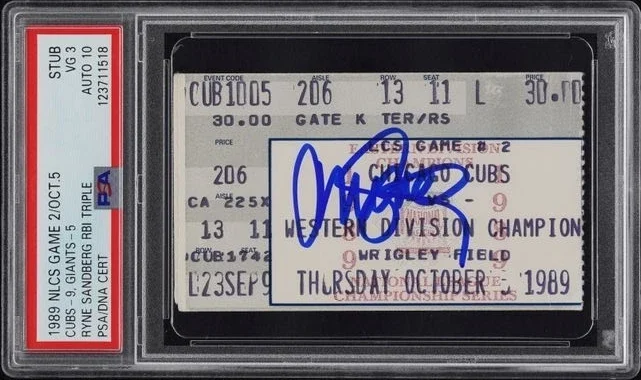
Sandberg starred in the 1989 NLCS but his team lost four of the five games to the Giants
Sandberg starred in the 1989 NLCS but his team lost four of the five games to the Giants
Ryne Sandberg rose to the occasion whenever October baseball arrived in Chicago. Although the Chicago Cubs reached the postseason only twice during his career, Sandberg delivered standout performances both times. His individual brilliance, however, never translated into a pennant for the North Siders.
The 1984 postseason marked Chicago’s first playoff appearance since World War II, and Sandberg immediately became a central figure. Fresh off his National League MVP campaign, the slick-fielding second baseman hit .368 in the NLCS against the San Diego Padres. He reached base consistently, worked quality at-bats, and sparked the offense throughout the series. Chicago grabbed a two-games-to-none lead before San Diego stormed back to win three straight.
Five years later, Sandberg again carried the Cubs into October. The 1989 club captured the National League East behind balanced pitching and timely offense. Sandberg thrived once more on the postseason stage, batting .400 against the San Francisco Giants in the NLCS. He collected six hits in fifteen at-bats and continued playing his trademark steady defense.
Even with those performances, Chicago fell short both times. Sandberg’s postseason résumé reflected the same consistency and professionalism that defined his Hall of Fame career. In 10 postseason contests, Sandberg hit while drawing six walks and scoring nine runs. He also piled up five doubles, a triple, one homer, and six RBI during that brief playoff résumé. October never rewarded him with a World Series trip, yet his play under pressure strengthened his reputation as one of baseball’s complete second basemen.
Shown here is a ticket from Game 2 of the 1989 National League Championship Series, one of Sandberg’s finest postseason performances. He ignited Chicago’s six-run first inning with a run-scoring triple down the right-field line off Rick Reuschel. Mark Grace followed two batters later with an RBI double that brought Sandberg home.
The Cubs struck again in the sixth after Jerome Walton singled, and walks to Sandberg and Dwight Smith loaded the bases. Grace then lined his second RBI double, driving home all three runners and sending Chicago to a 9-5 victory. That triumph became the final postseason win of Sandberg’s Hall of Fame career.
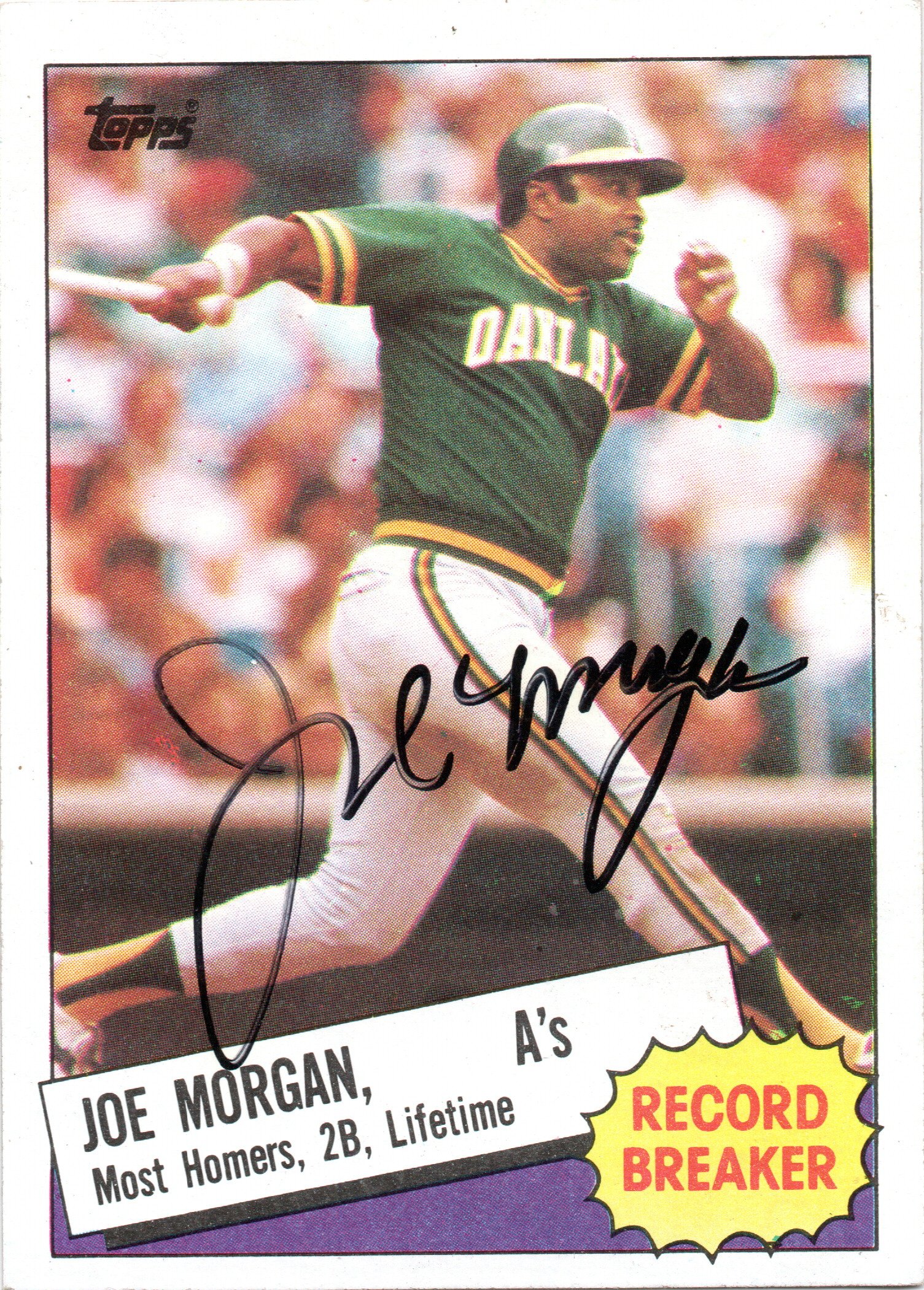
In 1997 Sandberg broke Joe Morgan's career record for home runs by a second baseman
In 1997 Sandberg broke Joe Morgan's career record for home runs by a second baseman
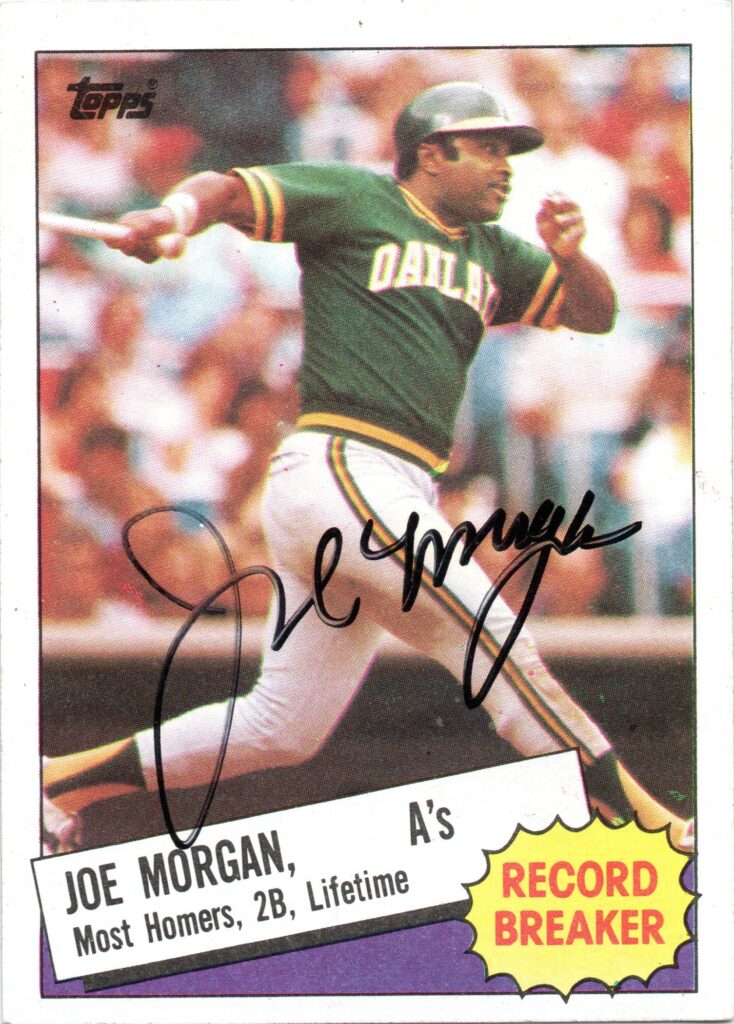
On June 24, 1984, Joe Morgan swung into history. He launched his 265th home run as a second baseman, surpassing Rogers Hornsby’s long-standing mark. The blast marked a defining moment for one of the position’s greatest players.
Morgan didn’t stop there. He pushed the record to 268 before retiring at season’s end, adding a final flourish to a brilliant career. Power at second base once seemed rare, yet Morgan redefined expectations with consistency and authority. His compact swing and sharp eye made him a constant threat.
That same season, a new force emerged in Chicago. Ryne Sandberg began his climb with the Chicago Cubs. He recorded the first of nine seasons with double-digit home run totals. Sandberg’s 1984 campaign delivered the National League MVP and announced his arrival among the elite.
Sandberg’s power only grew. He produced five seasons with at least 26 homers, including a career-high 40 in 1990. Over time, he chased down Morgan’s standard, moving past it in 1997. Sandberg finished with 277 home runs as a second baseman, setting a new benchmark.
Collectors still celebrate Morgan’s milestone. A Topps Record Breaker card commemorates the moment he passed Hornsby. Morgan later signed the card, turning a historic swing into a lasting keepsake.
Sandberg and Ron Santo had their numbers retired by the Cubs in a 2003 ceremony
Sandberg and Ron Santo had their numbers retired by the Cubs in a 2003 ceremony
Ryne Sandberg earned his place among the greatest players in Chicago Cubs history through excellence on both sides of the ball. The 1984 National League MVP combined power, consistency, and defensive brilliance across an outstanding career. Sandberg collected 10 Major League Baseball All-Star Game selections, nine Gold Gloves, and eight Silver Slugger Awards while becoming the face of Cubs baseball during the 1980s. Fans admired his quiet confidence and relentless professionalism every season he wore Chicago’s uniform.
The Cubs honored Sandberg’s impact in 2003 by retiring his famous number 23 at Wrigley Field. That ceremony also celebrated another franchise icon, Ron Santo, whose number 10 joined Sandberg’s among the club’s retired numbers.
Santo anchored third base for Chicago from 1960 through 1973 and built one of the finest résumés in team history. Only one Cubs position player produced more WAR than Santo, while Sandberg ranked directly behind him. Santo also finished fourth on the franchise home run list and fifth in RBI, cementing his legacy as one of Chicago’s greatest sluggers.
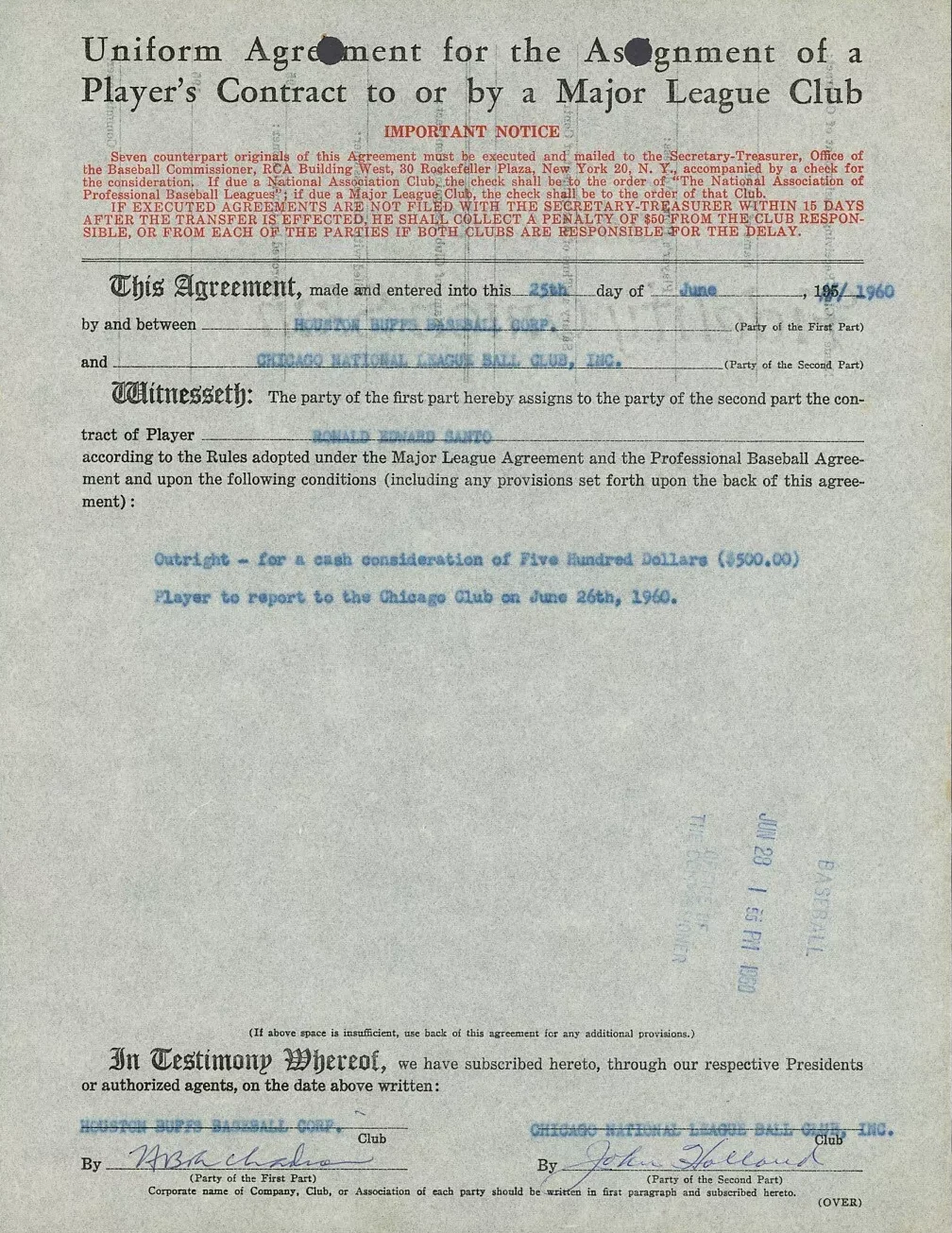
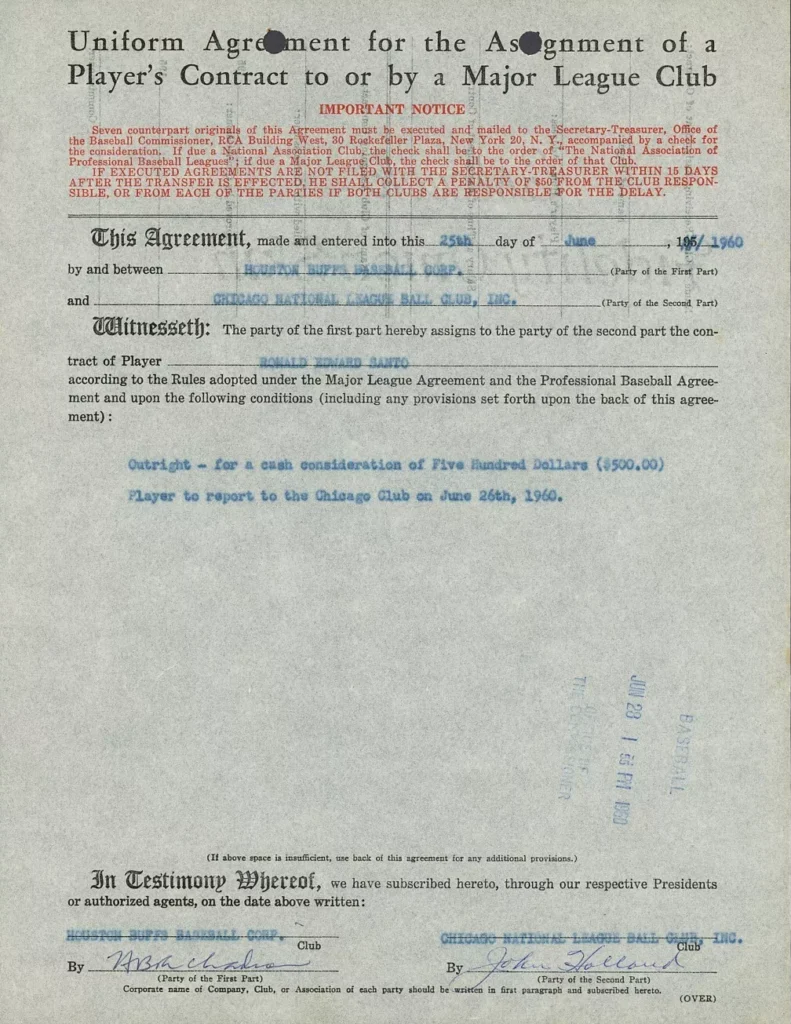
One remarkable artifact connects directly to Santo’s rise in baseball. The original document promoting him to the major leagues still survives, preserving the moment Chicago welcomed another future legend into the clubhouse.

In 2004 Jeff Kent broke Sandberg's career record for home runs by a second baseman
In 2004 Jeff Kent broke Sandberg's career record for home runs by a second baseman

In 1997, Ryne Sandberg seized the standard for power at second base. He moved past Joe Morgan and set a new career mark, redefining the position’s ceiling. For years, Sandberg’s total stood as the benchmark for infield pop.
Time, however, always brings a challenger. On October 2, 2004, Jeff Kent delivered the swing that changed the leaderboard. Playing for the Houston Astros, Kent crushed his 278th home run while stationed at second base. That blast pushed him past Sandberg and into the top spot all time.
Kent’s climb relied on remarkable consistency and thump. He produced 20 or more home runs in twelve different seasons, a rare feat for any middle infielder. Pitchers never found an easy lane, and mistakes often disappeared into the seats.
Durability and power defined his run. Kent finished with 351 home runs while playing second base, the most in history at the position. His overall total reached 377, underscoring his sustained excellence across a long career.
Sandberg raised the bar, but Kent reset it. The position never looked the same after their era.
In the collection is this contract between Kent and Topps Chewing Gum. Kent was a veteran of 102 big league games when he signed this on February 24, 1993. That season was the last of Sandberg’s ten-straight All Star campaigns.
Sandberg was inducted into the Hall of Fame in 2005 along with 5-time batting champ Wade Boggs
Sandberg was inducted into the Hall of Fame in 2005 along with 5-time batting champ Wade Boggs
Ryne Sandberg’s glorious 16-year MLB career makes him one of the best second basemen in baseball history. His career numbers include 2,386 hits, 403 doubles, 1,318 runs, 282 homers, and 1,061 RBI. It all adds up to a Cooperstown induction.
The Hall of Fame opened its doors to Sandberg in a July 31, 2005 ceremony. Inducted along with Sandberg was five-time batting champion Wade Boggs.
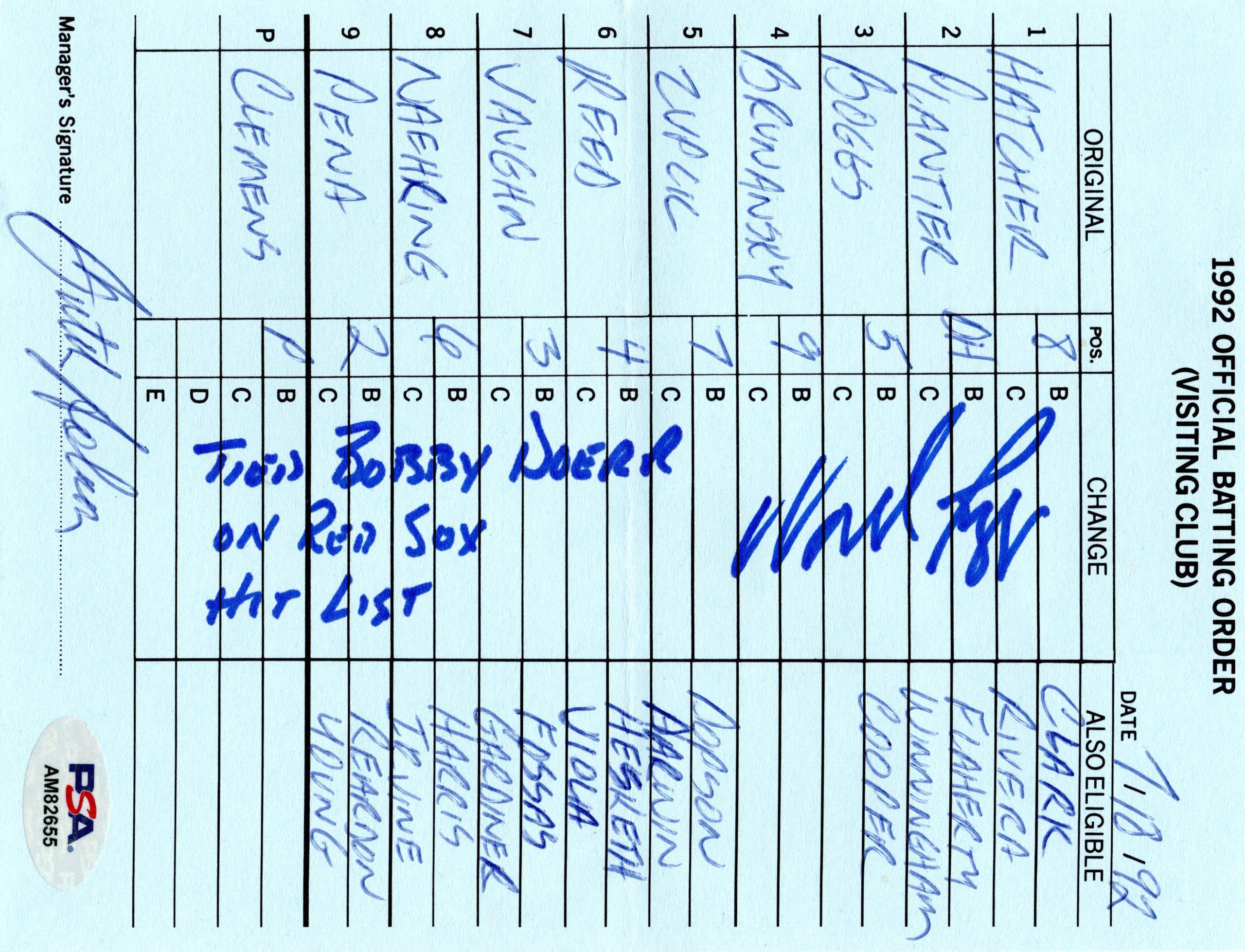
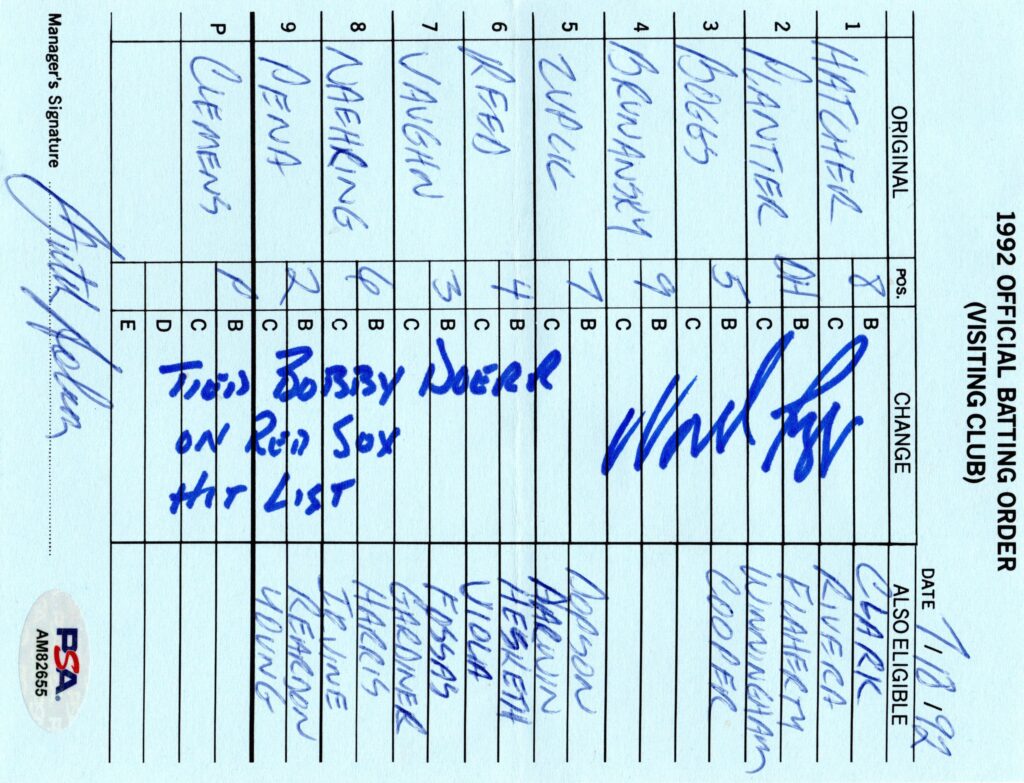
Shown here is a historically relevant lineup card linked to Boggs. It comes from the contest on July 18, 1992 featuring Boggs’ Red Sox and the Minnesota Twins.
In the top of the first inning Billy Hatcher laced a double down the first base line. After Phil Plantier grounded out to the right side to advance Hatcher to third, Boggs came up to bat.
On Scott Erickson’s 0-1 pitch Boggs dumped a short fly ball into left field to score what proved to be the game’s only run. The single was Boggs’ 2,042nd career hit as a Red Sox player to tie with Doerr on the all-time list.
Third baseman Boggs signed the lineup card adding the inscription, “Tied Bobby Doerr on Red Sox hits list”.
Carl Yastrzemski (3,419) is tops, more than 750 hits ahead of #2 man Ted Williams, who first broke Doerr’s record. Coming in third is Jim Rice (2,452), followed by Dwight Evans (2,373). Boggs left Boston with 2,098, good for 5th on the Red Sox list.
Two years after his induction, Sandberg embarked on a managerial career
Two years after his induction, Sandberg embarked on a managerial career
After entering the National Baseball Hall of Fame and Museum in 2005, Ryne Sandberg felt baseball pulling him back toward the dugout. He returned to the game in 2007 as manager of the Peoria Chiefs, the Class A affiliate of the Chicago Cubs. That assignment launched a steady climb through the managerial ranks.
Sandberg advanced to the Double-A Tennessee Smokies in 2009 before earning a promotion to the Triple-A Iowa Cubs the following year. Success followed him there as well, and he captured Pacific Coast League Manager of the Year honors in 2010. Chicago considered him for its open managerial position after Lou Piniella stepped away, but the organization chose another direction.
Instead of remaining in Iowa, Sandberg returned to the organization that first signed him professionally. He spent two seasons managing the Triple-A Lehigh Valley IronPigs within the Philadelphia Phillies system. Opportunity arrived on August 16, 2013, when Philadelphia dismissed Charlie Manuel and handed Sandberg a three-year contract.
He inherited a struggling club sitting 14 games below .500 and guided the team to a respectable 20-22 finish. The Phillies repeated a 73-89 record in 2014 before stumbling badly in 2015. Sandberg resigned after a 26-48 start, ending his managerial career with 199 victories.
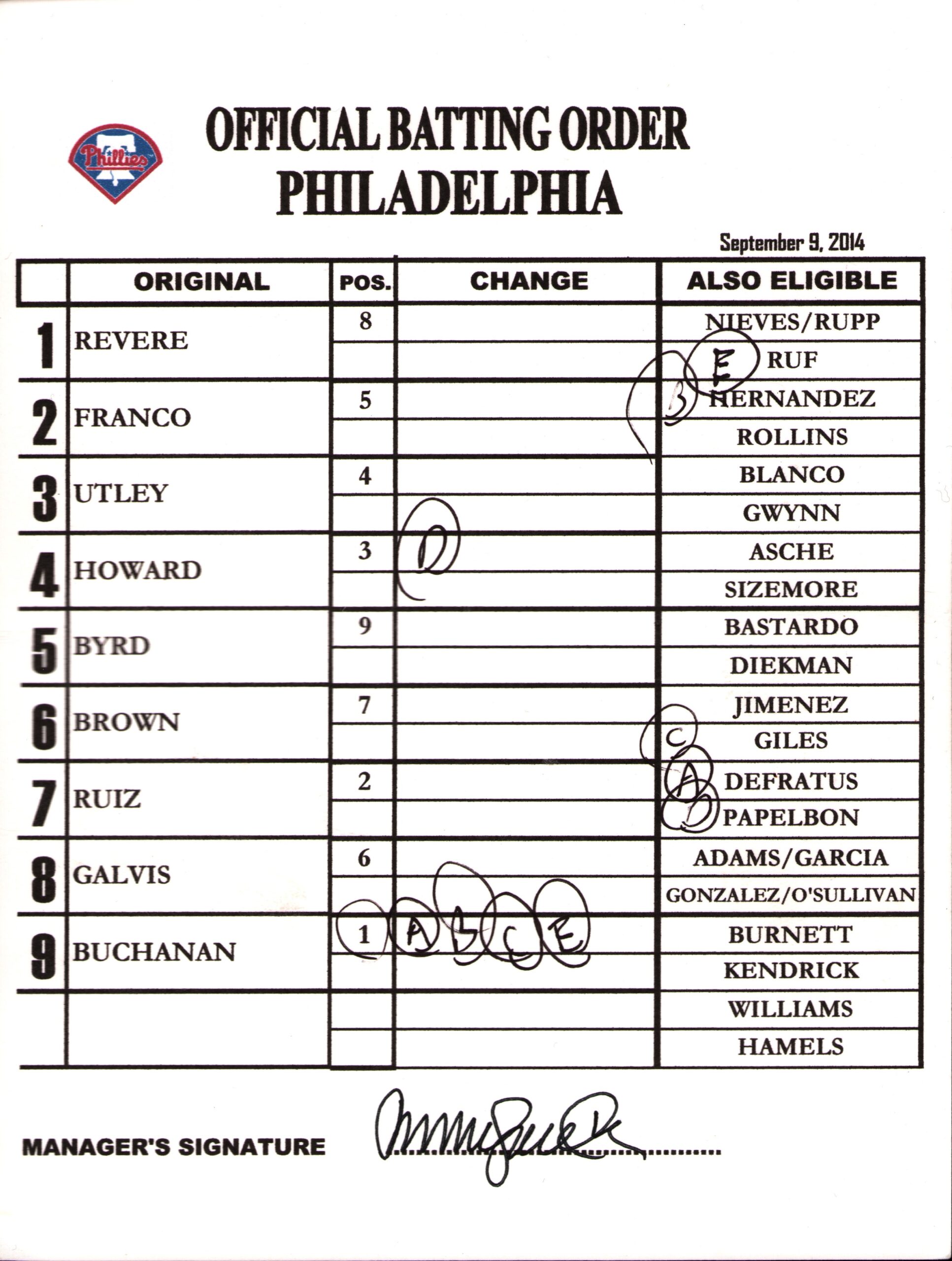
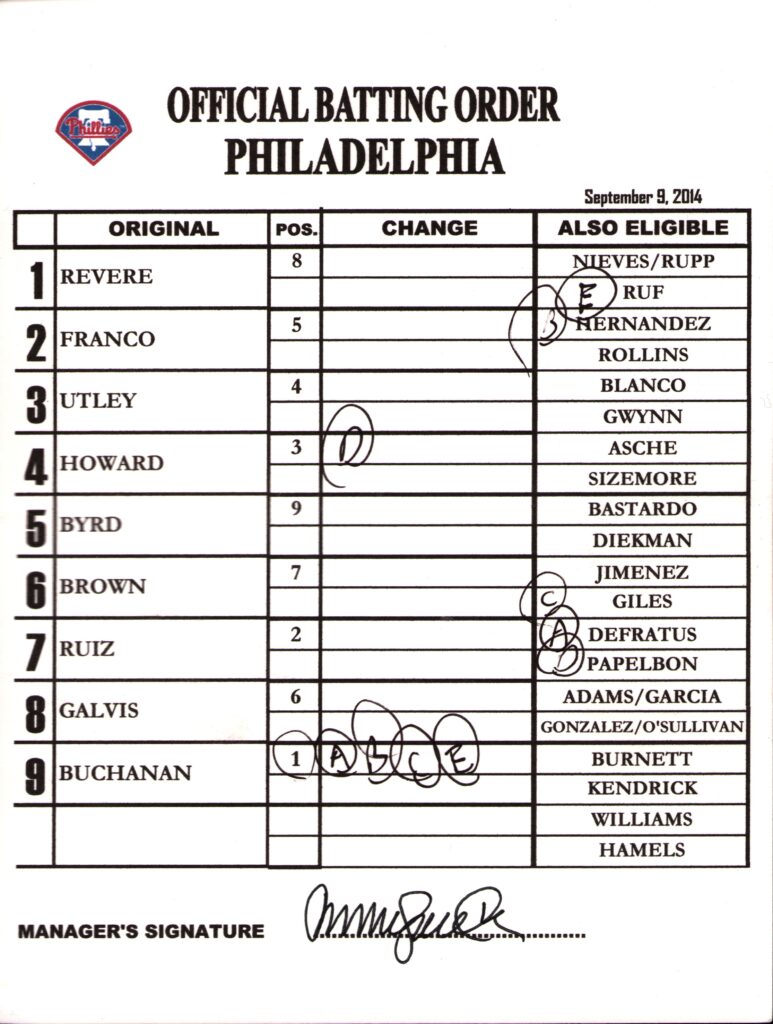
Shown here is a lineup card from September 9, 2014 signed by Sandberg at the bottom as Phillies manager. His club beat the Pirates 4-3 at Citizens Bank Park.