Pie Traynor

| Birthdate | 11/11/1899 |
| Death Date | 3/16/1972 |
| Debut Year | 1920 |
| Year of Induction | 1948 |
| Teams | Pirates |
| Position | Third Base |
A 17-year career with the Pirates left Pie Traynor with a .320 career average and 2,416 hits earning him induction as the Hall’s first 3rd baseman.
Leave a commentIn the collection:

Traynor was selected for each of the first two All Star Games
Traynor was selected for each of the first two All Star Games

The date was April 13, 1935 when Pie Traynor posted this letter to his wife Eve. The Pirate third baseman addressed the envelope to “Mrs. Harold J. Traynor” thereby providing his autograph.
An outstanding third baseman before World War II, Traynor was selected for each of the first two All Star games in 1933 and 1934 even though his very best years were behind him.
He finished with a 2,415 hits and a .320 lifetime average. Before Traynor was elected to the Hall of Fame in 1948, Cooperstown had no third baseman.

Traynor got his nickname for having a "Pie Face"
Traynor got his nickname for having a "Pie Face"

Do you know the origin of Harold Traynor’s nickname? A grocery store owner near his childhood home in Somerville, Massachusetts gave him the moniker that would stick with him the rest of his life.
Apparently the store owner called Traynor, “Pie Face” which was later shortened to “Pie” by his friends.
How much did Traynor identify with the nickname? In this 1935 letter to his wife the 36-year old closed it by signing, “Pie”.

Pie Traynor's autograph is highly desired and widely available
Pie Traynor's autograph is highly desired and widely available

Most of the Traynor autographs that survive today are similar to this index card in which the third baseman has written, “Pie Traynor”. That makes the first image on this page a bit remarkable.
Much less common is the more formal, “Harold Traynor” as shown on that envelope. Traynor’s 1948 induction year gave him 24 years of life as a member of the Hall of Fame. This combines to make Traynor’s autograph widely available to collectors.

Elbie Fletcher writes of teammate Pie Traynor's abilities
Elbie Fletcher writes of teammate Pie Traynor's abilities

Elbie Fletcher enjoyed a 12-year Major League career, most of which with the Pirates. Here Fletcher writes about Pie Traynor, “In 1939 I was sold to the Pitts. Pirates and ‘Pie’ Traynor was the manager, a great break for me. He was a ‘Hall of Famer’, an outstanding third baseman, and an excellent hitter. What more could you ask for?”
Fletcher led the league in on-base percentage in 1940, ’41, and ’42. The following year the sweet-fielding first baseman was an All Star. Unfortunately he then lost two seasons to World War II. He returned to the Pirates and played three more seasons before retiring at age 33.
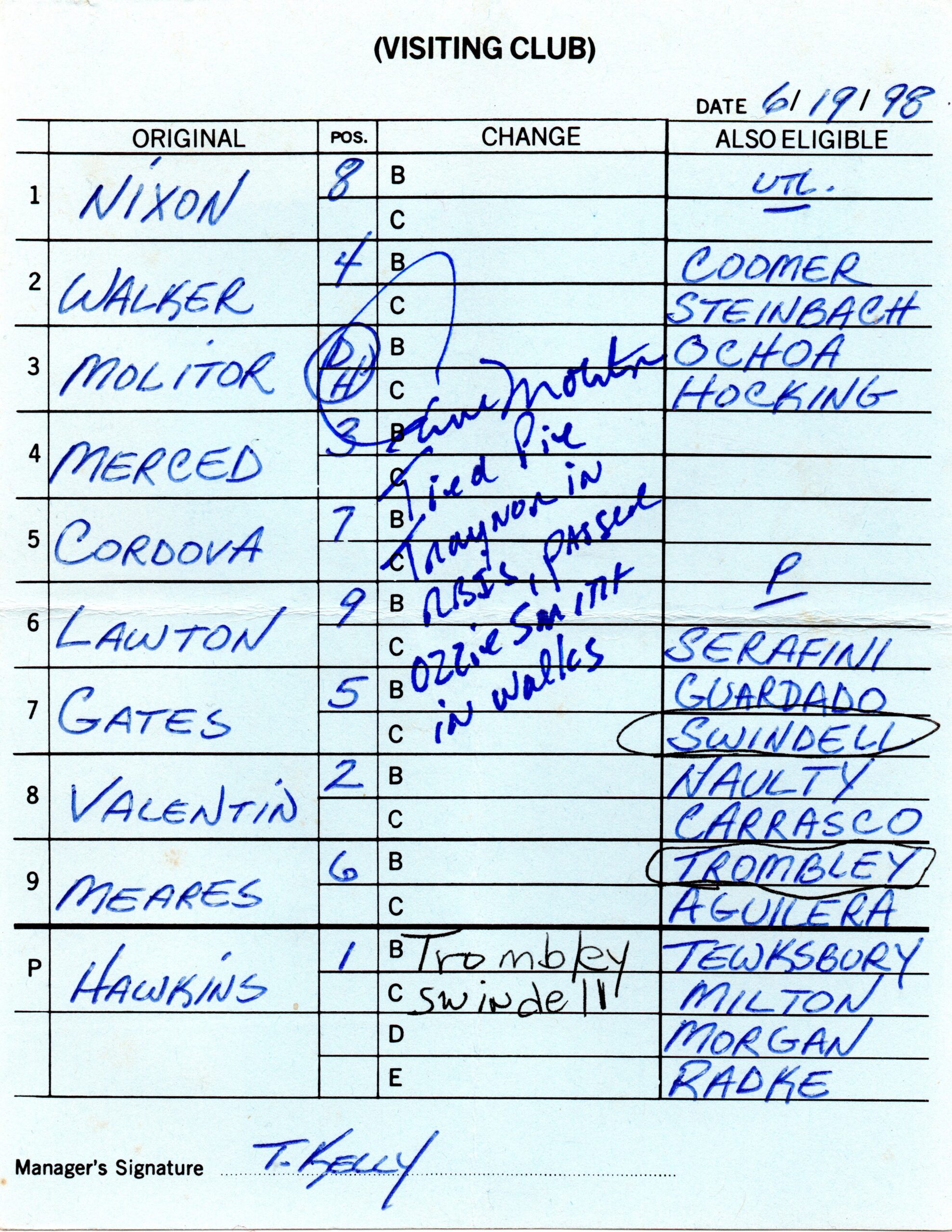
At his retirement in 1937, Pie Traynor's 1,273 RBI ranked 24th on the all-time list
At his retirement in 1937, Pie Traynor's 1,273 RBI ranked 24th on the all-time list
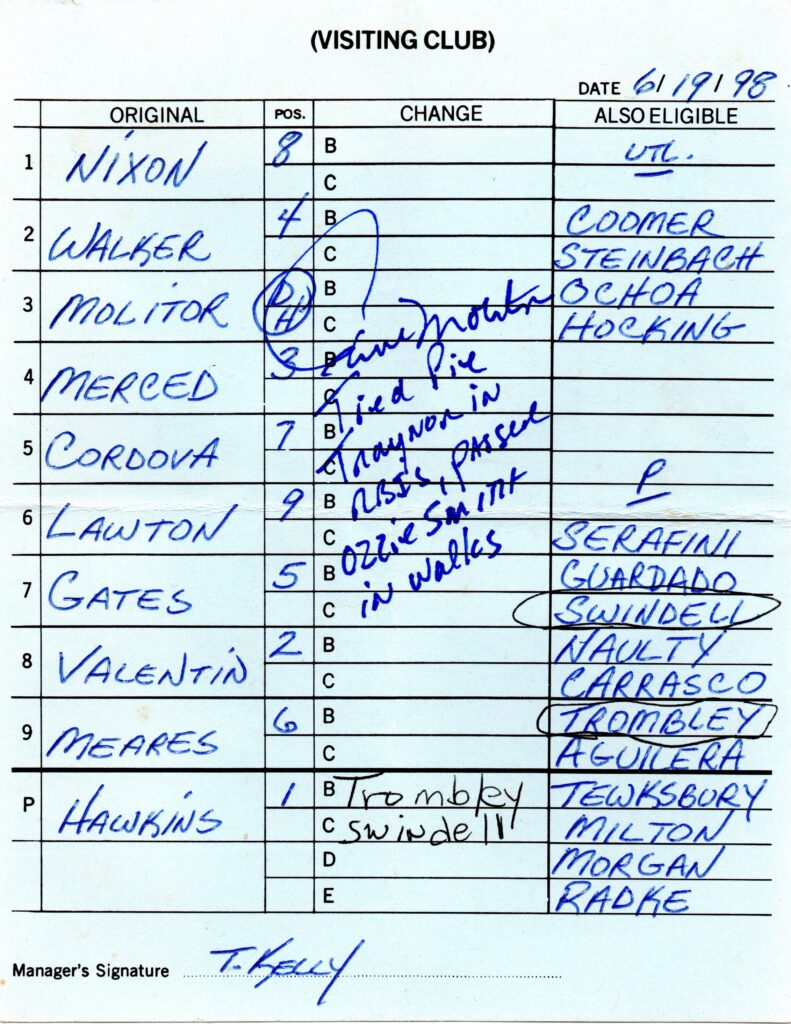
When Pie Traynor retired in 1937, he ranked among baseball’s statistical elite across several major categories. He stood 24th in RBI, 35th in hits, 49th in doubles, and 29th in triples. Traynor also ranked 41st in total bases and 50th in games played.
For decades, players steadily pushed Traynor down those leaderboards. Paul Molitor eventually became one of the few to pass him in every category. Their careers spanned dramatically different eras, yet their numbers eventually intersected.
Shown here is a Twins lineup card from June 19, 1998. That night, Molitor drew two walks, scored once, and added a sacrifice fly. The run-producing play gave him his 1,273rd career RBI, tying Traynor on the all-time list.
Molitor did not stop there. He drove in 34 more runs before retiring later that season, finishing with 1,307 career RBIs. That total ranked 71st when Molitor walked away from the game.
The lineup card captures another milestone from that same night. Molitor signed the card and added the inscription, “Tied Pie Traynor in RBIs, passed Ozzie Smith in walks.” His pen turned an ordinary lineup card into a snapshot of baseball history.
Traynor’s numbers once placed him among the game’s statistical leaders. Molitor’s longevity eventually carried him past those marks, one category at a time.
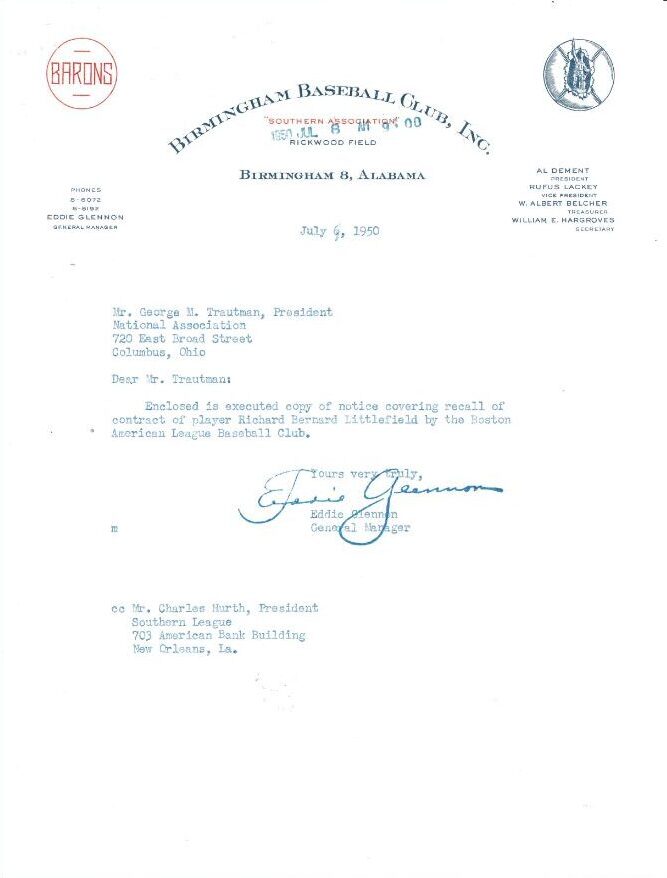
Pie Traynor was inducted into the Birmingham Barons Hall of Fame
Pie Traynor was inducted into the Birmingham Barons Hall of Fame
Among the many accolades Pie Traynor earned was induction into the Birmingham Barons Hall of Fame in 2009. He was one of four who earned the distinction that year. The others included am Hairston, Harry Hardin “Zipp” Newman, and Glenn West.
The Barons Hall describes Pie on its website,”At the age of 22, Traynor hit .336 and collected 37 stolen bases as a member of the Barons during the 1921 season. He went on to hit .320 in 17 seasons with the Pittsburgh Pirates and became the first third baseman elected to the Hall of Fame in 1948.”
Shown here is a correspondence on ornate Birmingham letterhead. Dated July 6, 1950, it is signed by Eddie Glennon, Birmingham Barons Hall of Fame class of 2010. The letter is to George Trautman, the president of the National Association.
Glennon writes of the recall of Dick Littlefield for his big league debut. Littlefield is best remembered as the pitcher the Giants traded to the Dodgers for Jackie Robinson on December 13, 1956. Rather than report to his rival team, Robinson retired from the game.



Why do people even consider WAR for players before 1950? I just finished reading a blog from someone who thought Traynor did
not belong in the HOF because his WAR wasn’t high enough. There is not enough known, statistic wise, about replacement players in
those early years.